 {|get_lang_name}
 {|get_lang_name}
Product Consultation
Your email address will not be published. Required fields are marked *


A buyer for a 400-desk insurance office ordered against a single line in the specification: "ergonomic mesh task chair, adjustable." Six weeks after delivery, 61 of the 400 units came back with the same complaint. The lumbar pad sat roughly 40 mm too low for anyone under 1.70 m. The chair matched the description and missed the people sitting in it.
That gap is what most real examples of ergonomics are about. The useful ones are never slogans. They are measured adjustments — a seat depth in centimetres, a recline angle in degrees, an armrest span in millimetres — each carrying a number you can check before a purchase order is signed.
The short version: examples of ergonomics fall into three families — posture and alignment, force and contact stress, and environment and movement. Every credible example inside those families has a target range attached. If a supplier cannot quote the range, you are looking at styling, not ergonomics.
Content
These are the examples that come up most often in seating procurement, grouped by what they actually control. The ranges given are working targets for 5th–95th percentile adults and should be re-checked against the body-size data of the destination market.
Body dimensions move every target. A chair that fits a Dutch warehouse team over-supports a Vietnamese assembly line, and the correct fix is adjusting seat depth and lumbar travel, not adding foam. The relationship between body measurements and chair geometry is worth reading in full — see how body measurements shape chair design.
Feet flat, knees between 90° and 110°. A 40–52 cm gas-lift range covers most adults; a fixed-height chair fails everyone outside it.
Leave 5–8 cm between the back of the knee and the seat edge. A sliding pan beats a fixed 50 cm pan in any mixed-body market.
The apex should meet the lower back near L3, standing 15–25 mm proud of the backrest and adjustable through roughly 15 cm of travel.
Elbows near 90°, shoulders relaxed, internal span 45–50 cm. Flip-up arms are what let a chair tuck under a 68 cm desk.
A 110°–135° recline with a synchro-tilt mechanism spreads load along the backrest. A locked upright back concentrates it.
Screen 50–75 cm away, top edge at or just below eye level, gaze angled 15°–20° downward. Cheap to fix and still the most common complaint.
Elbows 90°–100°, wrists neutral, extension under 10°. Negative-tilt trays help; fat wrist pads usually make the angle worse.
Wrists pressed on a hard desk edge, thighs pinched by a firm seat front. Radius the edge and keep front foam around 30–50 mm.
With a fixed 72 cm desk and a 1.55 m user, a footrest is the correct solution — not a taller chair and not a cushion.
Table 72–75 cm, seat 43–45 cm, 25–30 cm of knee clearance. A chair that breaks this ratio stays uncomfortable however good the upholstery is.
Counter stools 60–65 cm, bar stools 70–75 cm, each with a perimeter footrest so feet never dangle and cut circulation.
Change position every 30–45 minutes. Sit-stand desks, saddle stools and kneeling chairs work mainly by forcing that switch.
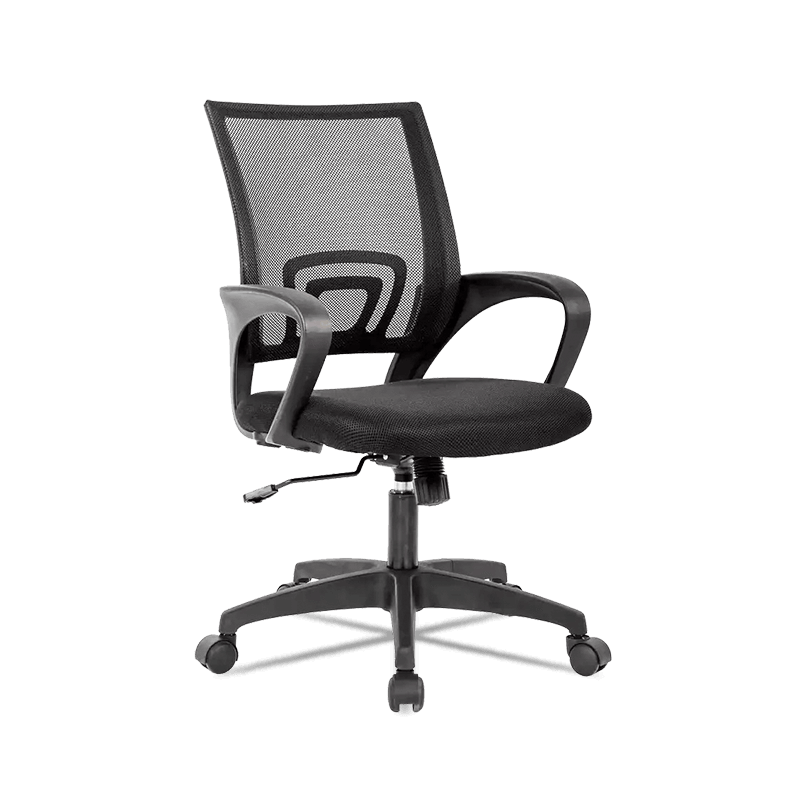 MC-7802 Adjustable Mid-Back Mesh Office Chair with Lumbar SupportA height-adjustable mesh task chair with lumbar support, armrests and swivel casters for flexible home or computer workstations where frequent position changes matter.View Product →
The examples above only pay off if the mechanism behind them is real. This is the comparison most buyers never run, and it is where volume orders quietly go wrong.
Working ranges reflect common 5th–95th percentile targets; re-check them against the body-size data of your destination market before writing a purchase order.
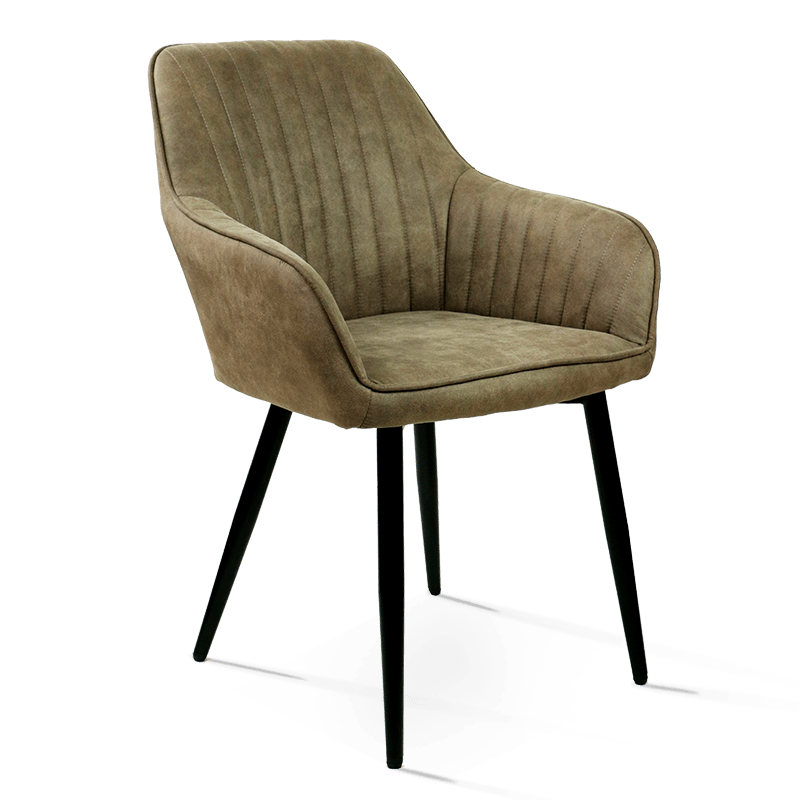 MC-2110 Thickened Velvet Ergonomic Dining Chair with ArmrestsA thickened velvet dining chair with an ergonomic backrest and armrests, suited to modern homes and waiting areas where seated comfort and support are compared.View Product →
Buyers compare foam thickness and fabric weight. They rarely compare backrest angle, which moves load far more than either. The chart below indexes seated spinal load at 100 for an upright 90° back and shows how it falls as the backrest opens up.
Indices of this kind appear throughout seating biomechanics work. Use them to compare two designs against each other, never as a clinical measurement of an individual sitter.
Different applications weight the examples differently. A gaming buyer cares about armrest articulation and recline range; a dining buyer cares about the seat-to-table ratio and front-edge pressure. Typical wholesale order mixes look roughly like this.
Shares are indicative of typical mixed wholesale programmes across office, home, hospitality and esports channels, not a census of any single market.
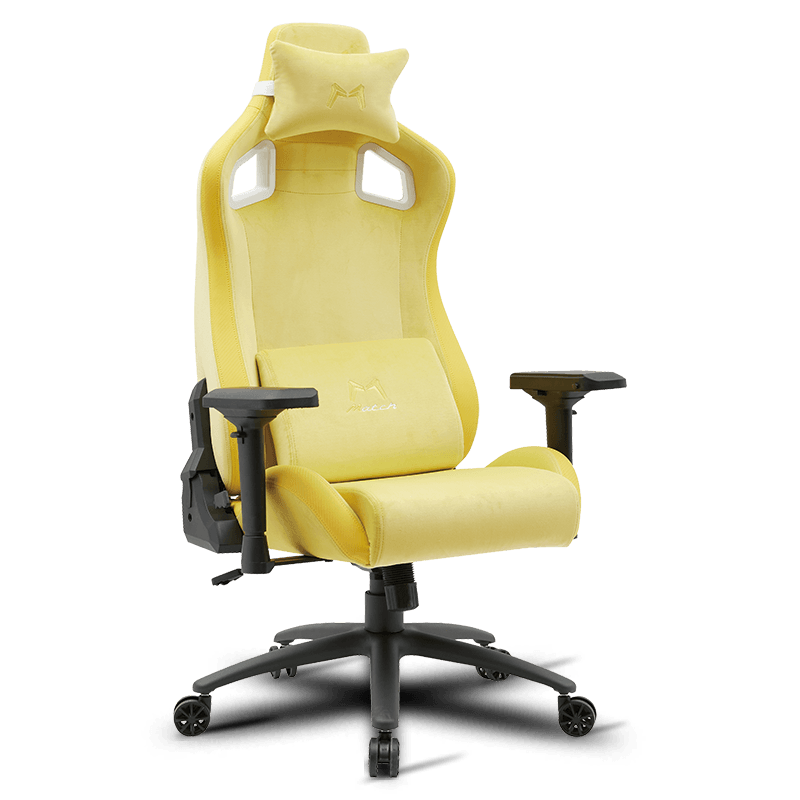 MC-9213 Gaming Chair with 4D Armrests and Adjustable Lumbar SupportA faux-leather gaming chair with 4D armrests, adjustable lumbar support and recline, aimed at esports rooms and mixed office, meeting and leisure settings.View Product →
Ask the buyer which percentiles they actually staff. 5th–95th is the normal target; 1st–99th roughly doubles the cost of adjustment hardware.
Seat depth, lumbar travel and armrest span drive most returns. Write ranges into the purchase order, not adjectives.
Send two units to the site and sit the shortest and tallest staff in them for a full shift before the bulk order is placed.
Confirm gas-lift class, caster type for the actual floor surface, and mesh tension after a 20,000-cycle compression test.
Run 50 units for 30 days and log complaints by part. A cluster against one component is a design problem, not a user problem.
Ergonomic performance degrades quietly. Foam takes a permanent set, mesh loses tension, gas lifts lose pressure, and a chair that fitted a user in year one stops fitting in year three. Build these checks into the supply agreement.
Ergonomics is easiest to defend when it is boring: a documented range, a tested mechanism, and a service interval. Buyers who ask for those three things get chairs that stay comfortable long after the novelty of the design wears off, and suppliers who can quote them win the repeat order.
Your email address will not be published. Required fields are marked *
Copyright © Anji Mingchuang Furniture Co., Ltd. All Rights Reserved.
