 {|get_lang_name}
 {|get_lang_name}
Product Consultation
Your email address will not be published. Required fields are marked *


Put a 152 cm user and a 196 cm user at the same 740 mm desk, and both will tell you the keyboard sits in the wrong place — for opposite reasons. Fixed desks land at roughly 720–760 mm in most offices, which happens to suit the seated elbow height of an average-height adult and almost nobody else. The wrists bend back, the shoulders creep toward the ears, the forearms reach forward, and by mid-afternoon the complaint has moved from the hands to the neck.
The short answer
Set the chair first, the keyboard second. Feet flat on the floor, knees near 90°, seat height within about a centimetre of your popliteal height. Then bring the elbows to 90–110°, forearms level or sloping slightly down toward the keys, and place the home row at elbow height or 0–3 cm below it, with the keyboard tilted back 0–15°.
That baseline matters more than the keyboard itself. Splits, tenting kits, negative-tilt plates and keyboard trays are all fine-tuning on top of a seat height that is already correct. Get the seat wrong and no keyboard geometry rescues the posture, because the shoulder has to compensate for every centimetre of mismatch between elbow height and key height.
Content
A keyboard sits on a surface, so once the desk is fixed, its height above the floor is fixed too. The only variable you can actually move is you — and you move by adjusting the chair. The chain runs in one direction: seat height sets popliteal support, seat height plus torso geometry sets elbow height, and elbow height sets the correct keyboard surface height.
The arithmetic is simple enough to do at a desk with a tape measure. Seated elbow rest height above the seat pan runs at roughly 14% of stature; popliteal height, which is what the seat should match, runs at roughly 25%. For a 175 cm adult, that puts the seat at about 44 cm, the elbow at about 69 cm above the floor, and a fixed 740 mm desk roughly 5 cm too high. Five centimetres does not sound like much until you notice that the shoulder must lift the entire arm to cover the gap. That is why people with nominally "correct" workstations still finish the day with a tight upper back.
Two chair features do most of the work. A gas lift with a usable seat range of at least 12 cm covers most adult statures, and padded, height-adjustable armrests let the forearm rest rather than hover. Seating built around genuine lumbar support keeps the pelvis from sliding forward, which is what drags the shoulders down and closes the elbow angle you worked to set.
Seat height
Match popliteal height within 1 cm. Feet flat, thighs level, nothing dangling.
Foot support
If the desk forces the seat upward, add a footrest instead of letting the feet hang.
Armrest height
Armrests meet the forearm at rest. If they lift the shoulder, they are too high.
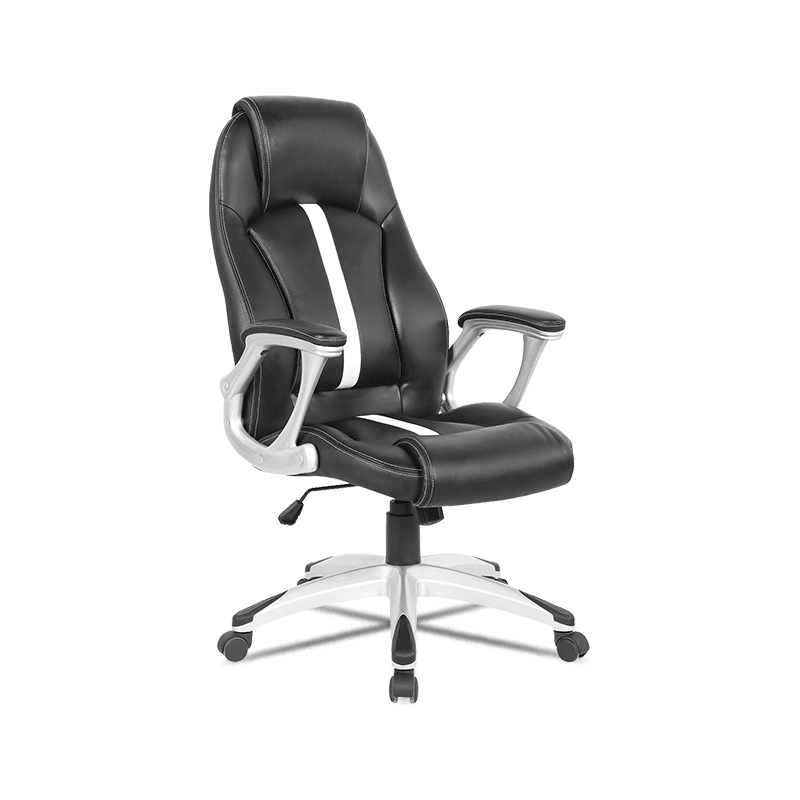 MC-7109 High Back Executive Office Chair with Lumbar SupportPU leather executive chair with adjustable height, tilt mechanism, padded armrests, and lumbar cushion; review for home office or conference seating fit.View Product →
The figures below are typical adult anthropometric ranges, shoes on, following the BIFMA G1 and ISO 9241-5 approach to adjustability. They are starting points, not prescriptions. Measure popliteal height and elbow rest height on the actual user before a purchase order is written.
Notes: ranges assume shoes with a 2–3 cm heel; the target home-row height assumes a 0 to −15° tilt and a home row roughly 20–25 cm in front of the torso.
For teams that cannot measure everyone, sizing the chair to a percentile band is the practical compromise. That is also the reasoning behind adjustable-height office chairs sized for every body type: one range in the specification replaces a stack of individual measurements.
Spec sheets quote a gas-lift stroke — usually around 10 cm — and stop there. What matters is the usable seat height range: the span between the lowest and highest stable positions under load, which is typically 2–4 cm narrower than the stroke. Below is what different ranges cover across an adult working population.
Indicative modelling against adult stature distributions; real coverage shifts with the market and with footwear habits.
A four-centimetre range is a fixed-height chair with a marketing department. Eight centimetres covers about two-thirds of adults; twelve covers most. Sixteen or more is what shared and multi-user spaces should specify, because the penalty for missing the range is not discomfort alone — it is equipment sitting unused after the second week.
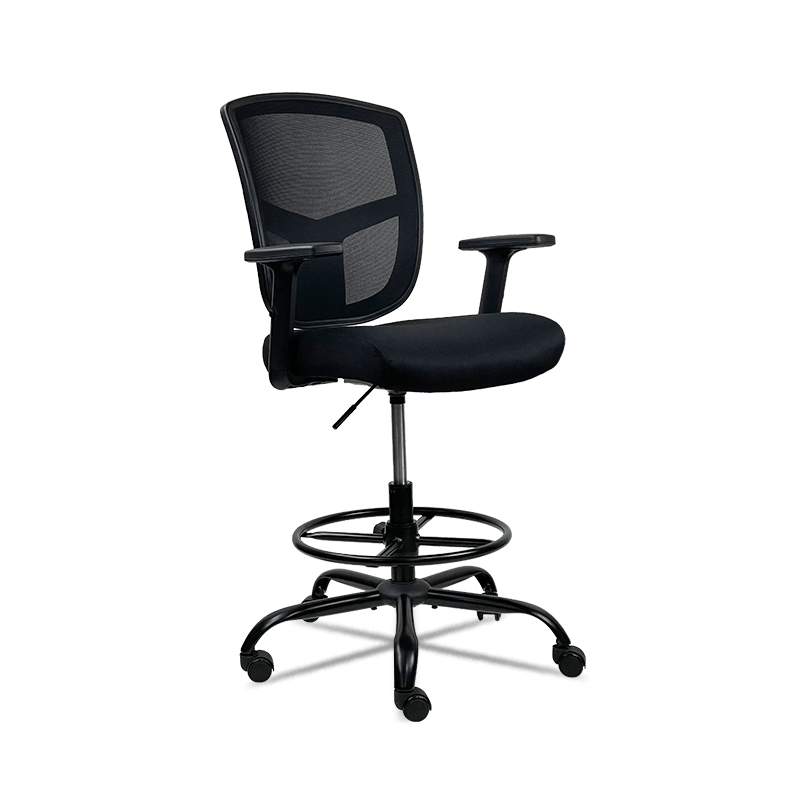 MC-7803 Mid Back Mesh Office Chair with Adjustable ArmrestsBreathable mesh mid-back chair with lumbar support, adjustable armrests, 100 mm gas lift, swivel casters, and height range for varied office, home, or gaming workstations.View Product →
Keyboard-height problems cluster in a handful of environments. The split below reflects how adjustable seating is used across the office, home and gaming projects that come through wholesale channels, and it explains why one fixed specification rarely fits an entire site.
Home office is the fastest-growing slice and the least supervised. Nobody measures a desk in a spare bedroom, and that desk is often the dining table. Gaming and streaming setups inherit the same problem: the chair is usually adjustable, but the keyboard sits on a 750 mm desk, so players compensate with forward head posture rather than with a footrest.
.png) MC-MC-2115 Adjustable Height Home Office Chair with Fixed ArmrestsCustom home office chair with knob-controlled seat height and backrest tilt, 360° swivel, rolling casters, and faux leather or velvet upholstery for compact workspaces.View Product →
MC-MC-2115 Adjustable Height Home Office Chair with Fixed ArmrestsCustom home office chair with knob-controlled seat height and backrest tilt, 360° swivel, rolling casters, and faux leather or velvet upholstery for compact workspaces.View Product →1. Measure
Popliteal height and seated elbow rest height, shoes on, to the nearest 5 mm.
2. Set the seat
Seat height equals popliteal height. Feet flat, thighs level, pelvis against the backrest.
3. Close the gap
If the desk forces the seat up, fit a footrest before raising anything else.
4. Set the elbows
Elbows at 90–110°, forearm level or sloping 1–2 cm down toward the keys.
5. Set the tilt
Home row at elbow height or 0–3 cm below it, keyboard tilted 0 to −15°.
6. Re-check
Every chair swap, every shared desk, every new keyboard, every three months.
The return on this work is not in the keyboard. A tray costs money, a split layout costs more, and both sit on a desk that may still be 5 cm too high. A 12 cm usable seat range costs nothing at the specification stage and cannot be retrofitted later. For a buyer equipping a hundred desks, the spending order should be: seat range and armrest adjustment first, footrests second, keyboard accessories third. Buyers who invert that order end up paying for ergonomic keyboards that are still placed at the wrong height.
Your email address will not be published. Required fields are marked *
Copyright © Anji Mingchuang Furniture Co., Ltd. All Rights Reserved.
