 {|get_lang_name}
 {|get_lang_name}
Product Consultation
Your email address will not be published. Required fields are marked *


By three in the afternoon the ache has settled at the front of the hip, not the lower back. You shift your weight, cross the other leg, stand up for a minute, and it fades, then it comes back before the next meeting ends. That pattern is a load problem, and in most offices it is created by the geometry of the chair rather than by anything else in the room.
The short answer
Seat pan depth, seat height, and seat surface angle decide how much compression the hip joint carries through a working day. When the seat lets the knees sit level with or slightly below the hip crease, leaves five to seven centimetres of clearance behind the knee, and does not collapse more than about two centimetres under load, most end-of-day hip discomfort drops noticeably, usually before any treatment is needed.
The rest of this article explains why that works, which numbers to measure, and how to hold those numbers through a multi-floor order without paying for features that do not touch the problem.
Content
The hip is a ball-and-socket joint with a capsule at the front and a bursa over the outer point of the femur. Sitting drives the femur toward the pelvis, and the front of the capsule, the hip flexors, and the gluteal structures all take pressure in a fixed position for hours at a time.
Every five degrees of forward seat tilt removes roughly five to seven degrees of hip flexion. It is the fastest lever available.
A pan that is two centimetres too deep creates more pressure behind the knee than a seat that is one centimetre too low.
A recline lock and an unlocked tilt range change the load profile more than extra padding ever will.
Pain that persists at night, comes with a limp, or spikes with fever is not a chair problem and needs a clinician. For the ordinary end-of-day ache, the fix is usually mechanical.
Buyers who write "ergonomic chair" on a purchase order and stop there usually get whatever the supplier has in stock. These are the six numbers that actually change hip load.
Targets reflect common ergonomic fitting practice for mixed-population offices and should be verified against your own user measurements before they are written into a purchase specification.
A forward tilt or open-angle option also helps. Some buyers trial an ergonomic kneeling chair for users who cannot tolerate deep flexion, then keep it as a secondary seat rather than a replacement for every desk.
For specification work, a model such as the MC7109 ergonomic adjustable high-back executive office chair, which carries an adjustable lumbar cushion and a height-adjustable back, gives the seat-to-back relationship a working range instead of a single fixed angle.
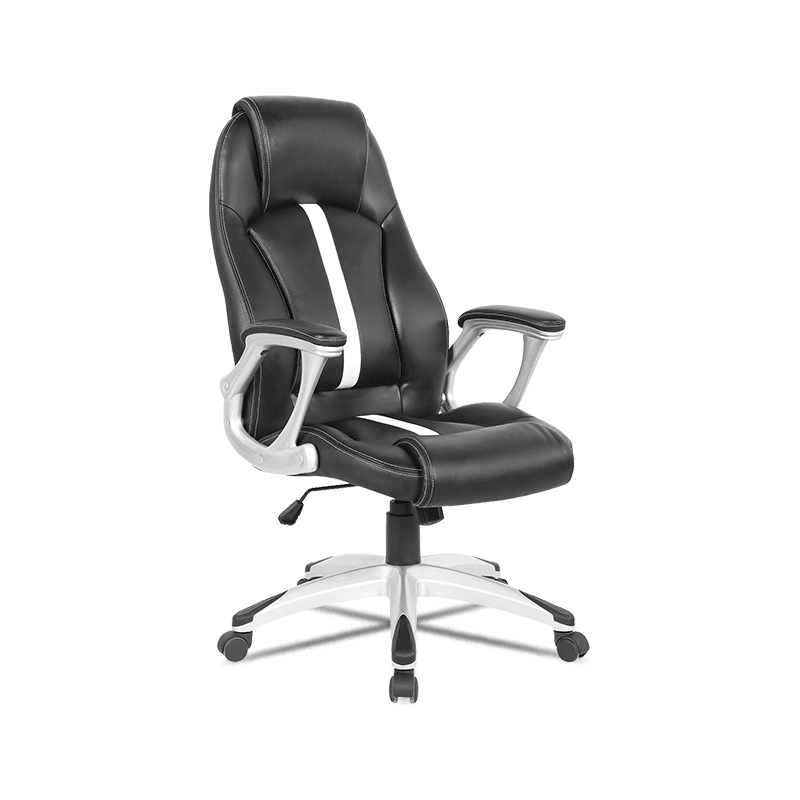 MC7109 Ergonomic High-Back Executive Office Chair with Lumbar CushionAdjustable lumbar cushion and height-adjustable back give the seat-to-back relationship a working range, relevant where seat angle affects hip flexion.View Product →
Seat angle is the quiet variable. It rarely appears on a quotation, yet it moves hip flexion further than any cushion upgrade. In fitting sessions the pattern is consistent, and the effect is larger for taller users with long femurs.
Bars show approximate hip flexion angle in degrees at each seat setting, measured at the thigh-to-torso relationship rather than at the mechanism. The trade-off is shear: a forward tilt without a footrest or a partial recline lock lets the user slide forward, which loads the lower back instead. Mesh backrests with adjustable lumbar pads hold the pelvis neutral while the seat tilts forward, which is why a chair like the MC7802 adjustable mid-back home mesh computer office chair with lumbar support is a practical pairing for users who need the open hip angle and back support at the same time.
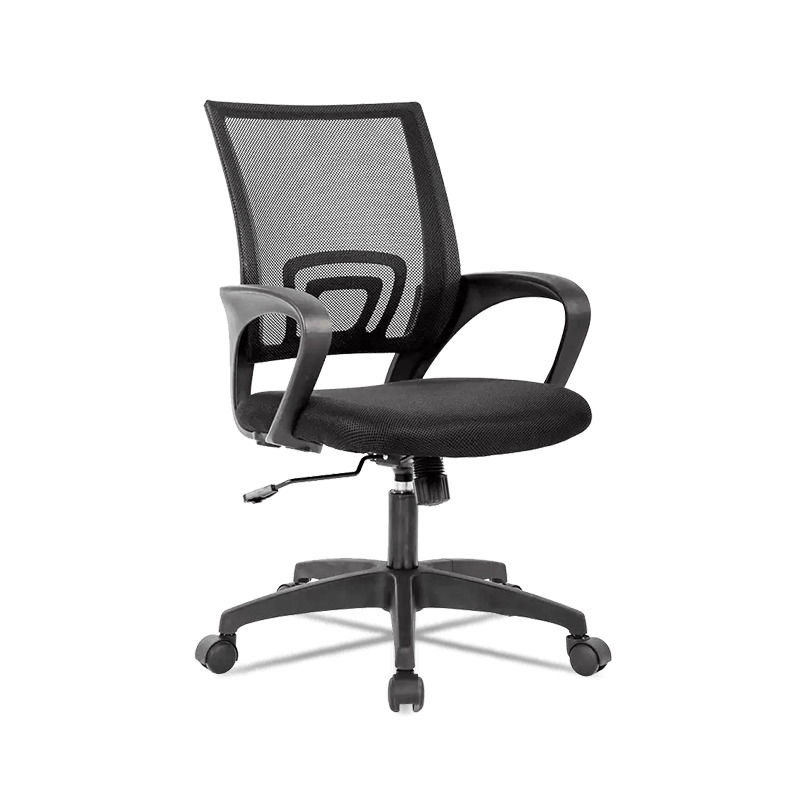 MC7802 Adjustable Mid-Back Home Mesh Computer Office Chair with Lumbar SupportMesh mid-back with lumbar support pairs open hip angle with back support, useful where shared seats and long sessions vary.View Product →
Not every workplace generates the same problem. Complaints cluster where one seat is shared by many body sizes, or where sessions run long without a break in the tilt angle.
The mix is drawn from enquiry and fitting patterns recorded across office seating projects and is indicative rather than a published market study. The buying lesson holds either way: hot-desking amplifies hip complaints because a single chair must fit a 155 cm user and a 190 cm user on the same afternoon, so adjustability range matters more than any individual setting.
Step 1: Measure the population
Popliteal height for the shortest expected user, often 38 to 42 cm, and the tallest, often 52 to 55 cm, defines the seat height range. Femur length defines the depth.
Step 2: Write ranges, not single values
Seat height 42 to 52 cm, seat depth 43 to 48 cm, seat tilt 0 to 5 degrees forward with a lock, lumbar height adjustable over 8 cm.
Step 3: Sample with real users for a week
Record where pressure appears at hour one, hour four, and hour seven. Feedback collected on delivery day tells you almost nothing.
Step 4: Price the spare parts, not just the chair
Gas lifts, casters, armrest pads, and seat foam are the parts that fail first. Confirm they are orderable separately before you commit to a model.
Step 5: Scale in phases, keep one model
Standardising across floors keeps cushions, covers, and mechanisms interchangeable, which turns a replacement into a five minute job.
For floors where several people share one desk, armrest height adjustment is often the feature that decides whether a chair is comfortable or not. A mid-back model with a quick-moving armrest, such as the MC7803 quick moveable mid-back mesh office chair with height-adjustable armrests, allows the shoulder position to be reset between users without tools.
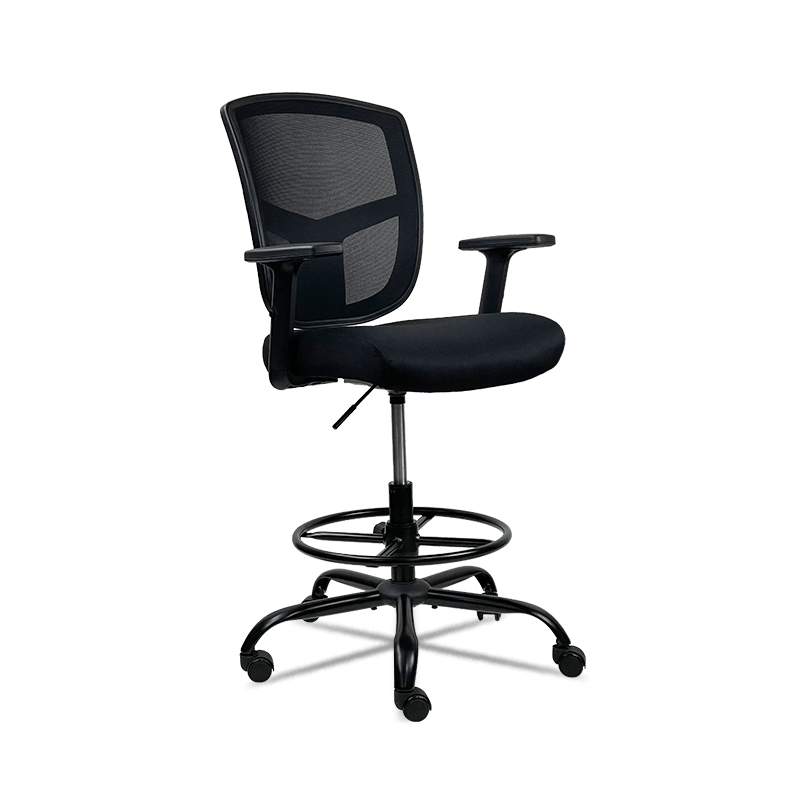 MC7803 Quick Moveable Mid-Back Mesh Office Chair with Height-Adjustable ArmrestsHeight-adjustable armrests let shoulder position reset between shared-desk users without tools, useful where seating must fit varied body sizes.View Product →
The return on this work is not in the chair price. A specification that fits the population avoids a second purchase two years later, and avoids the pattern where one department quietly buys its own seating because the standard issue model does not fit anyone properly.
For a deeper technical read, our complete guide to office chairs for hip pain covers mesh tension, lumbar geometry, and material trade-offs in more detail.
Hip pain from sitting in an office chair is rarely solved by one feature. It is solved by a seat height range that fits your shortest and tallest users, a pan depth that leaves clearance behind the knee, and a seat angle that opens the hip instead of closing it. Get those three numbers into the specification and the rest of the chair becomes a question of durability, upholstery, and how easily parts can be replaced five years from now.
We build seating for importers, contract buyers, and distributors, and specification questions about seat depth, tilt mechanisms, and adjustability ranges are the ones we answer most often. If you are drafting a requirement for a rollout, send the measurements and we will map them to a model range that can hold those numbers across the whole order.
Ergonomic Keyboard Height: How Chair and Elbow Height Set the Right Position
Oct 08,2026Your email address will not be published. Required fields are marked *
Copyright © Anji Mingchuang Furniture Co., Ltd. All Rights Reserved.
