 {|get_lang_name}
 {|get_lang_name}

Product Consultation
Your email address will not be published. Required fields are marked *


A European distributor returned 40 task chairs last year. Not because of the frame, not because of the gas lift or the mechanism. Because the armrest area and the front edge of the seat had pilled within four months — the exact spots where forearms, jeans and desk edges rub all day. The chairs had passed their static load tests. The fabric on the purchase order said one line: 100% polyester.
That is the real problem with office chair fabric material. It is not a single material. It is a specification, and when nobody writes the specification, the factory supplies the cheapest version that still reads “polyester” on paper.
The short answer
Buy fabric on four numbers: yarn content, fabric weight, Martindale abrasion and pilling grade. For a contract task chair in eight-hour daily use, hold the line at 100% polyester or a polyester/nylon blend, weight of 300 gsm or more, Martindale 40,000 cycles or more, and pilling grade 4 or above under ISO 12945-2. Below that line you are budgeting for claims in months 12 to 18. Well above it, you are paying for durability nobody will notice.
Content
Buyers treat “fabric” as one thing. A chair factory treats it as a four-layer supply chain, and each layer changes both the price and the failure mode.
Two properties get confused on spec sheets: abrasion resistance and pilling. They are not the same test. A fabric can survive 60,000 Martindale cycles and still rate pilling grade 3, because pilling measures loose fibres twisting into small balls on the surface, not yarn breakage under a rubbing head. Ask for both reports, separately.
Velvet is the category most often misread. The cut pile gives that soft, expensive look, and the same pile is where pills form. A velvet executive chair built for a boardroom is a sensible product; the same chair placed in a 24-hour call centre is not, unless the mill has quoted 50,000 cycles or more with an anti-pilling finish.
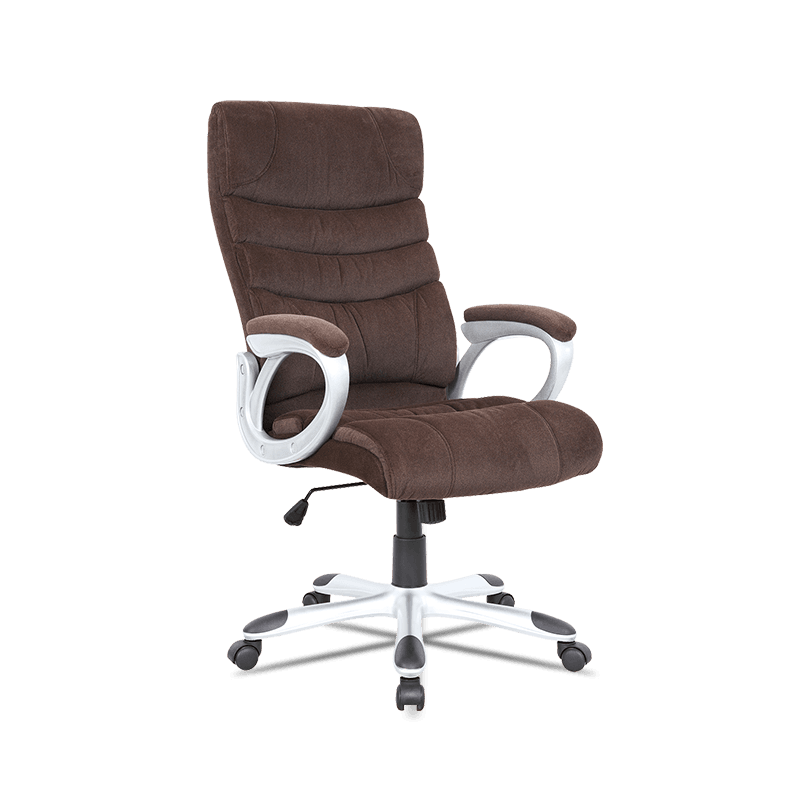 MC-7107 High-Back Velvet Executive Meeting ChairHigh-back velvet executive chair with adjustable height, recline tension control and padded armrests, intended for home offices, workstations and conference rooms.View Product →
When a buyer asks for the velvet look at scale, the practical move is to fix the fabric as a specification rather than a style word, then hold samples against that specification across every colourway in the order.
The comparison below covers the upholstery options most wholesale seating programmes actually use. Treat the ranges as production experience, not guarantees, and always confirm with the mill’s own batch test report before the fabric goes to the cutting table.
Air permeability rarely appears on a purchase order, yet it is the one property users complain about six months later. The bars below are relative air permeability values measured under the same test method, indexed to polyester plain weave at 100.
Read the gap between mesh and velvet: roughly three and a half times the airflow for the same seating footprint. That single number explains why “mesh back with a fabric seat” has become the default configuration in so many programmes — the backrest handles heat, the seat handles softness and cost. Pair the same seat cushion with a PU-coated cover and airflow almost disappears, which is usually where complaints start.
For buyers sourcing for warm or humid markets, this is the decisive criterion. A 300 gsm woven polyester that feels comfortable in a 24°C air-conditioned showroom behaves very differently at 30°C after six hours of sitting. Choosing breathable fabric chairs as a starting point, rather than retrofitting ventilation later, is generally the cheaper route through a tender.
Upholstery choice follows the end use, not the other way round. The split below reflects how fabric consumption typically distributes across office seating categories in a wholesale programme.
The practical takeaway is that most of your fabric volume will land in a task chair, where abrasion and pilling matter, not in a statement piece where appearance matters. Splitting the fabric library by category — one durable grade for task seating, one decorative grade for executive and lounge — prevents the common mistake of putting showroom fabric on a high-traffic product.
Step 1 — Fix the use case
Write down daily sitting hours, cleaning frequency and whether the chair sits near a window. Those three answers set the fabric grade before any sample is requested.
Step 2 — Draft the spec
Composition, weight, Martindale, pilling, colour fastness and flame retardancy. Six lines on a document prevent most of the arguments later.
Step 3 — Sample two mills
Request one running metre plus the test report from at least two mills. Quoted numbers without a report are marketing, not data.
Step 4 — Build one pilot chair
Sit on it for 72 hours, including at least one full working day. Check seam alignment on the seat front and how the cover behaves when compressed.
Step 5 — Verify colour
Measure with a spectrophotometer under D65 and target ΔE of 1.5 or lower. Eyeballing colour under factory lighting is how mixed batches happen.
Step 6 — Seal the golden sample
Keep a covered swatch plus the test report, referenced by number in the purchase order. Without it, “same as last time” means whatever the mill has in stock.
Step 7 — Audit each batch
Re-test pilling or abrasion once per fabric lot. Two failed lots in a row is a mill problem, not a luck problem.
Cleaning method follows the surface structure, not the fibre name. Getting this wrong is the fastest way to void a fabric warranty, because most seating warranties exclude damage from incorrect cleaning agents.
On compliance, the checklist depends on destination. For the United States, TB 117-2013 applies to upholstered seating components. For the United Kingdom, BS 5852 ignition source 0 and 1 covers most contract furniture. For the EU, REACH restricted substances and Oeko-Tex Standard 100 certification on the fabric are the usual requests, alongside colour fastness to light at grade 4 or above under ISO 105-B02.
Read the warranty wording carefully as well. Fabric coverage of two to three years is common against construction failure, while pilling, staining and normal colour shift are almost always excluded. If pilling claims are a recurring cost in your market, the fix belongs in the purchase specification, not in the warranty negotiation.
The same logic applies across the wider range — see how fabric upholstered office chairs are grouped by cover grade rather than by model number when a programme needs consistent replacements over several years.
Fabric is the cheapest part of an office chair and the most common reason for a return. A purchase order that names the composition, the weight, the Martindale result and the pilling grade costs nothing extra to write, and it converts a vague style requirement into something a mill can be held to. Start with the use case, specify the four numbers, keep a sealed swatch, and re-test each lot. Everything else about the chair — the mechanism, the base, the lumbar support — will usually outlive the cover if the cover is chosen properly.
Ergonomic Workstation Design: Dimensions, Chair Specs and Wholesale Sourcing
Nov 16,2026Your email address will not be published. Required fields are marked *
Copyright © Anji Mingchuang Furniture Co., Ltd. All Rights Reserved.
