 {|get_lang_name}
 {|get_lang_name}
Product Consultation
Your email address will not be published. Required fields are marked *


The defining feature of a truly successful modern living room armchair isn’t just its visual appeal—it’s the seamless integration of ergonomic science and sculptural design. The contemporary market has shifted decisively toward pieces that support the body’s natural posture without sacrificing aesthetic integrity. Unlike the rigid, formal armchairs of the past, today’s designs utilize advanced foam technologies and engineered spring systems to provide a "soft-but-firm" cushioning experience that cradles pressure points while maintaining spinal alignment.
We are seeing a clear departure from purely decorative seating. The modern accent chair functions as a micro-architecture within the room. Key ergonomic markers to look for include a seat depth of 21 to 24 inches to accommodate the average femur length, and a backrest angle reclined between 100 to 110 degrees, which research in environmental ergonomics identifies as optimal for both conversation and reading. The "nonchalant confidence" of a well-made lounge chair comes from this precise calibration, allowing the user to sit for extended periods without fatigue, making it a legitimate alternative to the sofa for daily use.
Manufacturers are now responding to the rise of remote work by blurring the lines between the lounge chair and the task chair. Mid-century-inspired frames, with their gently angled wooden legs and open base architecture, offer a visual lightness that contrasts with the deep, enveloping cushioning. This combination creates a stable reading environment where the user feels contained but not swallowed. The most versatile designs incorporate high-density foam cores wrapped in a softer memory foam or feather-fiber blend, providing the immediate comfort of a sink-in feel with the lasting resilience required to prevent the cushion from bottoming out over time.
Content
The silhouette of a modern armchair acts as a visual anchor, dictating the room’s traffic flow and focal points. A common misconception is that sculptural forms sacrifice comfort for art; however, the opposite is true when designed well. The sweeping curve of a barrel back, for instance, is not merely aesthetic. It creates an acoustic and physical cocoon that psychologically separates the sitter from the surrounding open space of a large living room. This is particularly effective in open-concept homes built after 2010, where defining distinct zones without walls is essential.
When selecting a silhouette, consider the "negative space" the chair creates. A chair on a thin, splayed metal base (often brass or matte black powder-coated steel) allows light and air to pass underneath, making a compact room feel larger. Conversely, a solid-base or skirted chair grounds the composition. Designers are currently gravitating toward rounded, organic forms that counterbalance the rigid horizontal and vertical lines of media consoles and shelving units. Introducing a soft, curved accent chair into a rectilinear room layout introduces biophilic undertones, subtly humanizing a tech-heavy space.
Fabric choice in a modern living room armchair is a negotiation between tactile luxury and mechanical durability. The term "your fabric of choice" implies customization, but the decision should be driven by the room’s specific friction and light exposure levels. Performance fabrics have revolutionized the market, moving beyond the rough textures of early synthetics to velvet-soft polymers that repel moisture and resist abrasion. A performance velvet rated at 100,000 double rubs on the Wyzenbeek scale will significantly outperform a standard cotton blend (which often fails at 15,000 rubs) while maintaining a lustrous sheen that adds depth to the upholstery.
Colorfastness is a critical but often overlooked factor. A living room armchair positioned near large windows must resist UV degradation. Solution-dyed acrylics and high-grade polyesters hold pigment through the entire fiber, preventing the fading that occurs in vat-dyed natural fibers. For households seeking sustainability without sacrificing modernity, recycled polyester and ocean-bound plastic fabrics now offer texture variations indistinguishable from virgin materials. The table below outlines the ideal fabric selection based on the primary functional demand of the armchair.
| Primary Use Case | Recommended Material | Key Performance Metric |
|---|---|---|
| Daily Lounge & Napping | Performance Velvet | Stain release & soft hand feel |
| Reading & Task Lighting | Textured Bouclé | Visual warmth & snag resistance |
| Guest Seating/Occasional | Top-Grain Leather | Patina development & easy wipe-down |
| Sun-Drenched Sunrooms | Solution-Dyed Acrylic | UV lightfastness & mildew resistance |
The tactile temperature of the fabric also affects perceived comfort. Leather and tight-weave synthetics can feel cold in air-conditioned environments, whereas wool blends and bouclé offer immediate thermal comfort. This psychological factor determines how inviting the chair looks and feels upon first touch, which is crucial for a piece meant to beckon guests into the living room.
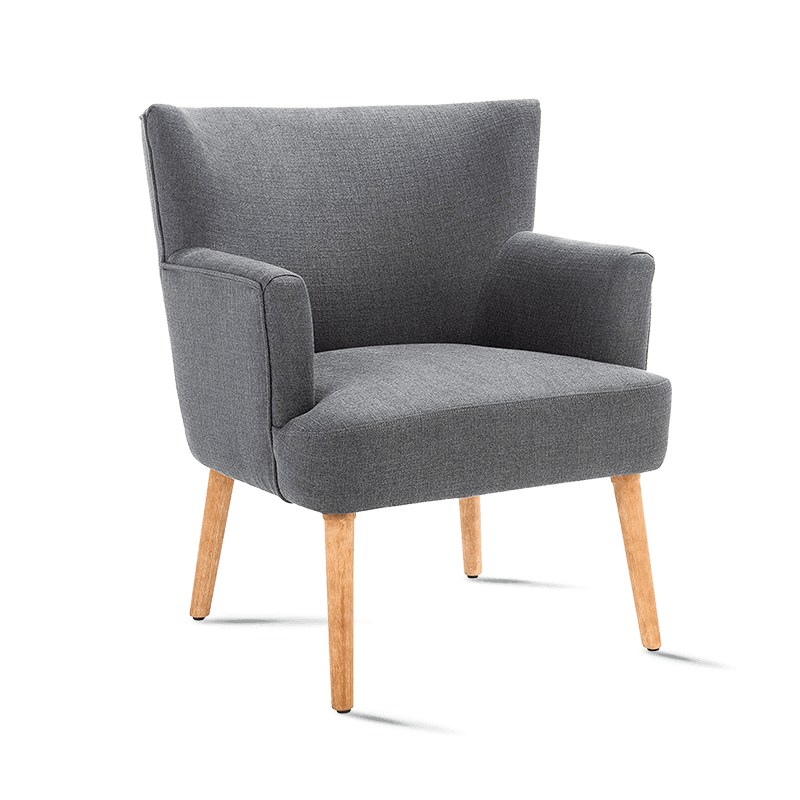
An armchair that looks perfect in a showroom can overwhelm a standard living room if the spatial chemistry is ignored. The modern accent chair demands breathing room. A common spatial error is placing the chair flush against a wall, which flattens its sculptural back and destroys the mid-century airiness of the design. To dress up a bedroom or enhance a living room, the chair must float. You need a minimum of 36 inches of clearance in front of the chair to allow legs to stretch out—without this, the ergonomic benefits of the lounge design are nullified.
The sturdy frame of a modern armchair acts as a low anchor, but it must be balanced by vertical elements. Place a floor lamp with a reach of at least 58 to 68 inches directly behind or beside the chair. This creates a triangulation effect, drawing the eye upward and defining the reading zone as a distinct room within a room. This composition naturally draws people in and signals the chair’s function as a retreat, much more effectively than a simple side table setup.
In smaller living rooms, a single modern armchair can visually replace a bulky two-seater loveseat. A pair of identical accent chairs, angled at 45 degrees toward each other with a small drinks table between them, offers seating for two guests while consuming less visual mass. The sturdy, tapered leg frame is critical here; chairs with visible legs allow light to travel under them, increasing the perceived square footage of the room significantly more than boxed-in designs.
The contemporary color strategy for a living room armchair has pivoted from strict matching to deliberate contrast. Rather than duplicating the sofa’s upholstery, designers now treat the armchair as the room’s chromatic counterweight. Data from recent interior design trend cycles indicates a 30% increase in the specification of deep jewel tones—emerald, sapphire, and oxblood—for accent chairs placed in neutral environments dominated by beige, greige, or warm white walls. This creates immediate focal depth without requiring pattern.
The psychology of color temperature also dictates spatial depth. A warm-toned chair (terracotta, ochre) visually advances, making a distant corner feel intimate. A cool-toned chair (charcoal, navy) visually recedes, widening a narrow living area. If the goal is a "nonchalant confidence," monochromatic textural layering is the safest route. For example, a cream bouclé armchair placed against a slightly darker greige wall loses its outline, blending comfort with sophistication and dressing up the space without shouting for attention.
Beneath the upholstery and foam lies the critical architecture of the frame, where engineered hardwood and precision joinery define a chair’s lifespan. A genuine mid-century-inspired frame uses kiln-dried hardwood, usually birch or ash, with reinforced corner blocks. This prevents the warping that plagues pine frames in humid climates. The suspension system is equally vital; an upgrade from standard sinuous springs to a hand-tied eight-way spring system shifts the chair from a disposable fast-furniture piece to an heirloom object. While the former provides a bouncy, hammock-like feel, the latter distributes weight evenly, protecting the foam core from premature collapse.
The nonchalant stance of these chairs often relies on subtle engineering details. Legs attached via metal brackets with leveling glides are superior to screw-in wooden dowels. They allow the chair to sit perfectly flush on uneven historic floors—a common reality in older homes where a modern armchair is introduced to dress up the space. If selecting a swivel base, prioritize a 360-degree cast aluminum mechanism with sealed ball bearings over plastic races, as this prevents the grinding noise and instability that emerges after a few months of regular use.
Protecting a modern armchair’s good-looking silhouette requires a maintenance protocol adapted to synthetic performance weaves. The "S" cleaning code, applied to solvent-clean-only fabrics, has been largely replaced by "W" (water-based cleaner) and "WS" codes in the modern home, drastically simplifying stain removal. For daily dust and skin oil accumulation, a simple weekly vacuum with an upholstery attachment is more effective than spot cleaning alone, as it prevents grit from abrading the fibers in high-friction areas like the headrest and armrests.
Specific stain response times are critical for maintaining the confidence you have in your accent piece. Red wine or coffee spills on a high-performance velvet should be blotted (never rubbed) immediately. The hydrophobic coating on the fibers gives you a roughly 30-second window to lift the liquid before it begins to penetrate the microscopic crevices. For oil-based stains, a dry-cleaning powder formula massaged gently into the fabric with a horsehair brush will draw out the lipids without breaking down the backing material of the cushion covers.
Breathable Mesh Office Chair: Ergonomic Support & Durability
Jul 13,2026Ergonomic Chair Office Guide: End Back Pain at Work
Jul 27,2026Your email address will not be published. Required fields are marked *
Copyright © Anji Mingchuang Furniture Co., Ltd. All Rights Reserved.
