 {|get_lang_name}
 {|get_lang_name}
Product Consultation
Your email address will not be published. Required fields are marked *


Buying one office chair is a product decision. Buying fifty is a procurement decision — and the two require entirely different frameworks. At scale, a wrong choice doesn't just affect one employee's comfort; it ripples across absenteeism rates, maintenance budgets, and the physical culture of an organization. Wholesale office chair procurement done well is a long-term investment in workforce health and operational efficiency. Done poorly, it generates replacement cycles, injury claims, and the kind of low-grade employee dissatisfaction that never makes it into a feedback survey but shows up in productivity data. This guide gives procurement managers and business owners a clear framework for getting it right the first time.
Content
The return on ergonomic seating is well-documented. OSHA's ergonomic guidelines note that musculoskeletal disorders — the category of injuries most directly linked to poor seating — account for a significant portion of workplace injury costs and lost workdays. Bulk ergonomic chair procurement is, in this context, a risk management decision as much as a procurement one.
The economics of wholesale purchasing also shift the value equation. Ordering in volume unlocks tiered pricing that is simply unavailable at retail — often 20–40% below comparable per-unit retail prices. When that discount is applied across an entire office floor, the savings typically exceed the cost difference between a budget chair and a properly specified ergonomic one. In other words, wholesale pricing makes it financially viable to buy the right chair rather than the cheapest one.
Uniformity is a secondary benefit that procurement teams sometimes underestimate. A consistent chair model across a workspace simplifies maintenance (spare parts, replacement cylinders, and casters are interchangeable), supports a coherent office aesthetic, and eliminates the informal hierarchy that emerges when employees notice that some desks have better chairs than others. Explore our full range of office chairs available for wholesale to see the breadth of options available for large-scale fitouts.
Not all chairs marketed as "ergonomic" meet the same standard. For bulk orders, verifiable certification is the most reliable proxy for quality, because it removes the need to evaluate each chair's design claims independently.
Two certifications matter most in the commercial office chair market:
Beyond certification, the ergonomic specification that most directly affects workforce fit is adjustability range. OSHA's seating guidelines emphasize that seat height should accommodate a wide range of users, with the seat pan adjustable to allow feet to rest flat on the floor for users of different statures. For a diverse workforce, this means specifying chairs whose pneumatic cylinder covers the 5th–95th percentile height range — roughly a seat height range of 40–53 cm (16–21 inches).
For deeper insight into how ergonomic features affect long-term productivity, see our analysis of the ergonomic benefits of executive office chairs.
Wholesale office chair procurement rarely involves a single chair type. Most organizations need two or three categories to address different roles and environments. Understanding where each type performs best prevents the common mistake of applying a single model across contexts where it doesn't fit.
| Chair Type | Best For | Key Specification Priority |
|---|---|---|
| Mesh task chair | Open-plan offices, call centers, hot-desking | Breathability, wide height range, Class 4 cylinder |
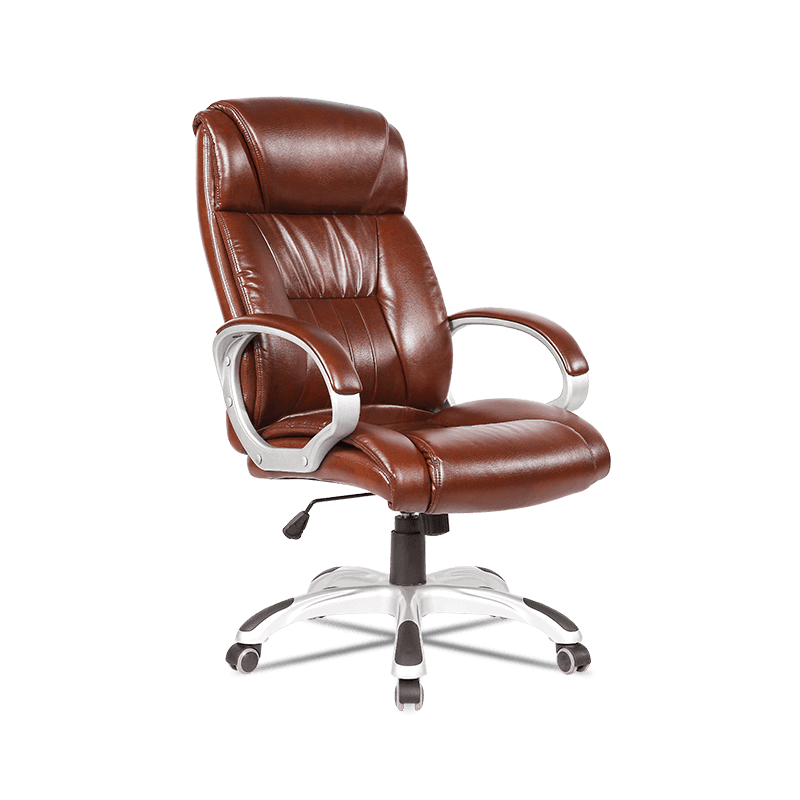
| Executive office chair | Management offices, boardrooms, client-facing spaces | High back, premium upholstery, full adjustability |
| Home office chair | Remote worker programs, compact workspaces | Compact footprint, comfort for solo use, aesthetics |
For general staff in open-plan environments, mesh office chairs for open-plan workspaces offer the best combination of breathability, durability, and adjustability. Their open-weave backs prevent heat accumulation during sustained sitting, and their lighter weight makes reconfiguring collaborative layouts straightforward.
For leadership and boardroom environments, executive office chairs for leadership and boardroom use serve a dual function: ergonomic support for the long hours executives actually work, and the visual authority appropriate to client-facing spaces. The distinction between these categories is not merely cosmetic — for a detailed breakdown of the functional differences, see our guide to the key differences between office chairs and executive chairs.
The chair specification matters. So does the supplier behind it. At wholesale volumes, supplier reliability, quality consistency, and after-sales support become as important as the product itself.
Factory-direct sourcing eliminates the middleman margin and gives buyers direct visibility into manufacturing standards, materials sourcing, and quality control processes. When evaluating a supplier, ask specifically whether they manufacture the chairs themselves or act as a trading company. A factory-direct relationship also makes customization — color options, logo placement, upholstery material — significantly more accessible and cost-effective.
Certification documentation should be verifiable, not just claimed. Request test reports for BIFMA structural testing and, where relevant, GREENGUARD or equivalent indoor air quality certification. Reputable manufacturers maintain current certification records and can provide them without delay.
Minimum order quantities (MOQ) vary significantly between suppliers. For organizations placing their first large order with a new supplier, the ability to begin with a smaller pilot order — say, 20–50 units across a department — before committing to full-scale procurement is a meaningful risk mitigant. Ask whether the supplier offers phased ordering programs.
Warranty terms are a reliable signal of a manufacturer's confidence in their product. A supplier offering less than three years on structural components and the gas cylinder is implicitly acknowledging that those components may not survive commercial use. For office environments where chairs are in use six to eight hours daily, five-year structural warranties should be the target.
Spare parts availability extends the economic life of a chair purchase. Casters, cylinders, and armrest pads wear before the chair frame does. A supplier who can supply spare parts years after the original purchase means a chair that lasts eight to ten years rather than four.
Wholesale chair procurement failures tend to cluster around the same recurring errors. Avoiding them is straightforward once they are named.
Selecting based on unit price alone. The cheapest chair per unit often has the highest total cost of ownership. Low-density foam compresses within a year. Low-grade cylinders lose height retention. Plastic bases crack under daily commercial use. A chair priced 30% lower that requires replacement in three years costs more than a properly specified chair lasting eight.
Skipping the sample and pilot phase. Catalogue images and spec sheets cannot substitute for physical testing. Before placing a large order, request sample units and have a cross-section of employees — including shorter and taller users — test them over several weeks. Pay particular attention to lumbar support placement, seat depth, and cylinder height range as experienced by actual users, not as specified on paper.
Specifying a single model for all roles. A mesh task chair optimized for a customer service team in an open-plan floor is not the right choice for a senior manager's private office — and vice versa. Matching chair category to role and environment produces better outcomes than enforcing uniformity for its own sake.
Ignoring the adjustability range relative to workforce demographics. If 40% of your workforce is outside the height range covered by a chair's cylinder, you have not bought an ergonomic chair — you have bought a chair that is ergonomic for 60% of your team. Confirm the cylinder range against actual workforce height data before finalizing specifications.
Overlooking lead times for large orders. Factory production, quality inspection, and shipping for bulk orders require lead time planning — typically eight to sixteen weeks for custom or large-volume orders from a factory. Procurement timelines that don't account for this frequently result in office fitouts delayed by seating that hasn't arrived, forcing the use of interim furniture that then lingers.
Failing to confirm spare parts availability. A chair without an accessible spare parts supply has a fixed lifespan equal to its weakest component. Before committing to a supplier at volume, confirm that cylinders, casters, and armrests are available as replacement parts and at what cost.
Adjustable Height Office Chair: Ergonomic Guide for Every Body Type
May 21,2026Adjustable Height Office Lounge Chair with Padded Armrest | Comfort & Ergonomics
Jun 03,2026Your email address will not be published. Required fields are marked *
Copyright © Anji Mingchuang Furniture Co., Ltd. All Rights Reserved.
